

Quick Takeaways
Hot-tire pickup takeaways
- Start with the surface: a mark on an intact film is different from coating that has softened, torn, lifted, peeled, or exposed concrete.
- Tire heat can be part of the conditions around a failure, but location alone does not identify the root cause; the slab, preparation, coating, application, cure, and moisture all deserve review.
- Do not choose a spot repair or full removal until the failure boundary and likely bond problem are understood.
Start With The Evidence
Is it a tire mark, tire tracking, or coating pickup?
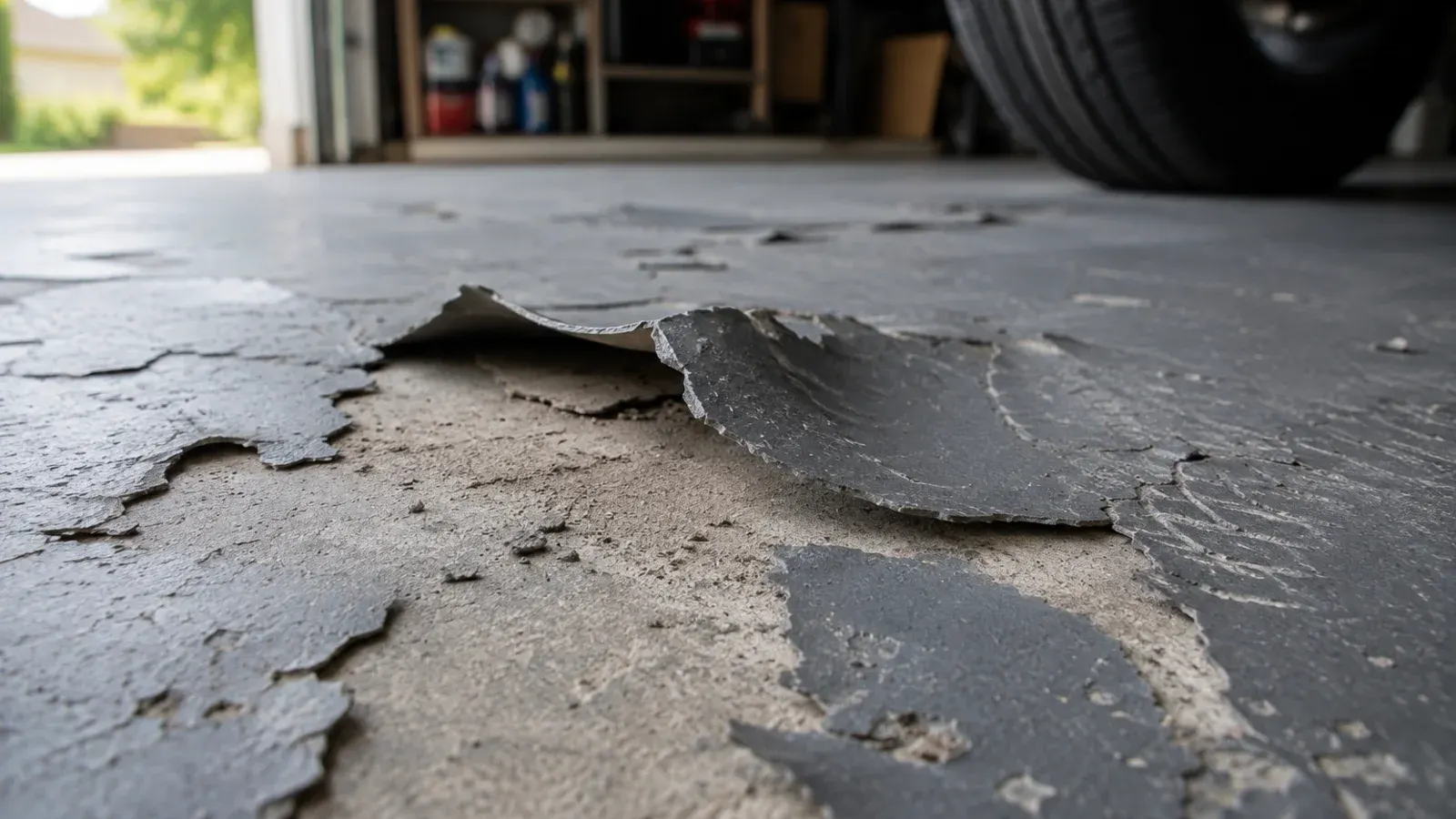
First look across the floor in low, raking light. An intact mark leaves the coating surface continuous: the color may be darkened, but there is no loose edge, missing film, exposed concrete, or material stuck to the tire. Gently cleaning a small area with a product approved for the installed finish may help identify surface transfer. Do not begin with a strong solvent, scraper, or abrasive pad; that can turn a diagnostic question into new damage.
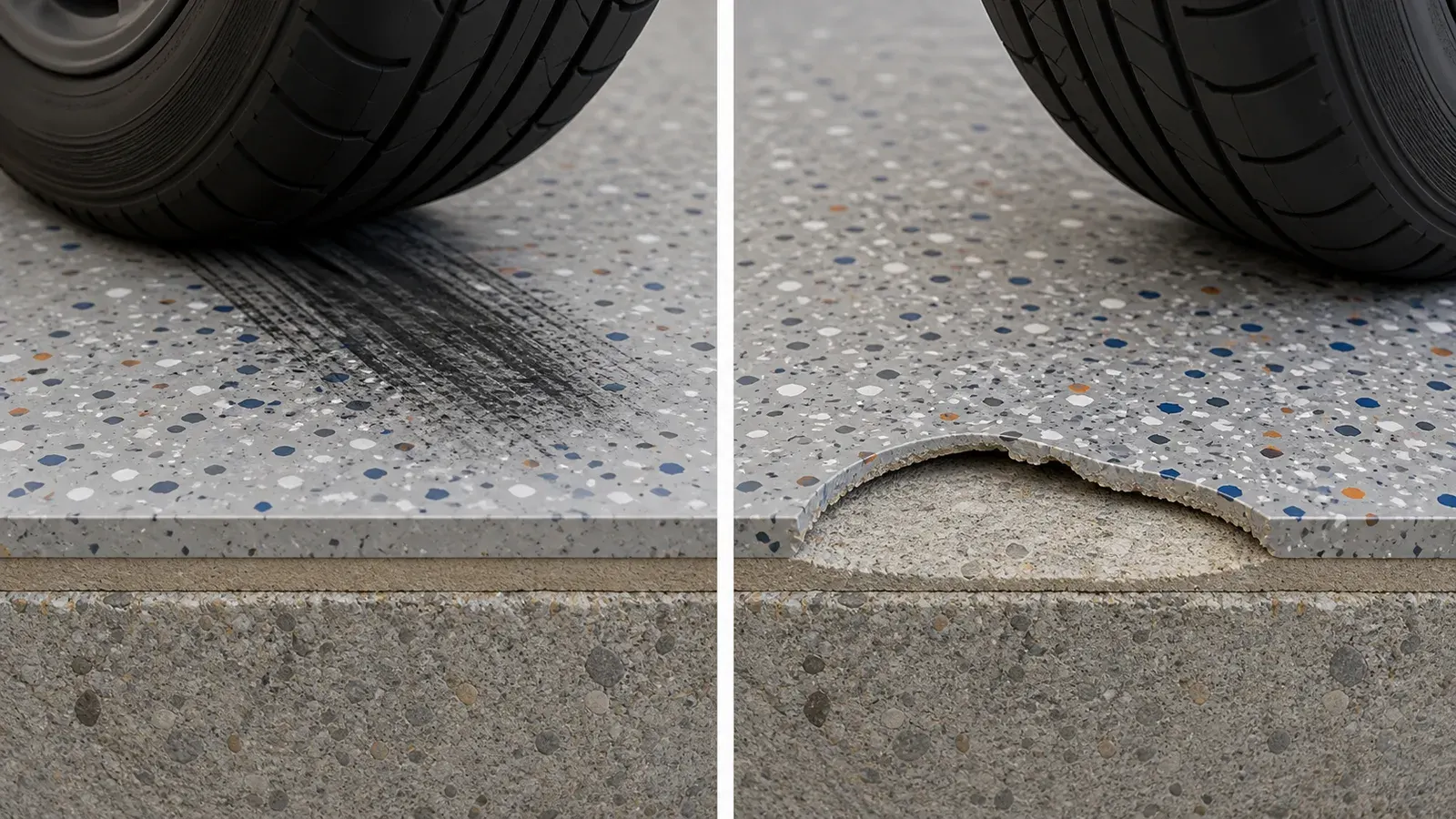
“Tire tracking” is a useful term for a visible print or transfer that can occur even when a product is described as resistant to hot-tire pickup. “Pickup” is the more serious physical condition: the coating softens or loses bond, adheres to the tire, and lifts, peels, tears, or leaves substrate visible. Because those outcomes call for different responses, a photo of a black tire shape by itself is not enough to diagnose failure.
Texas Heat Is Context
Why the symptom often appears where tires stop
Tires warm through driving and flexing. Euclid Chemical’s CP-22 bulletin describes how compounds used to keep rubber flexible can migrate from warm tires and discolor or interact with some film-forming sealers and coatings. That is one documented mechanism, not proof of what happened on every garage floor and not a statement about the products Ace installs.
Tire locations also concentrate pressure and repeated movement. A driver may brake, turn, or scrub the tread slightly while entering a garage, then leave the tire loaded in the same place. In a DFW summer, the tire and garage can be warm, but temperature alone does not establish why a film lifted. A weak or contaminated bond may simply become visible first where the floor receives that combined stress.
Compare all four parking positions, the edges of the affected area, and places where tires turn. Note whether the condition appeared immediately, after a return-to-service period, or months later. Those patterns help an installer separate a one-location contaminant or application issue from a broader system or slab condition.
A useful first inspection
- Look: Is the film continuous, or is concrete exposed?
- Touch: Is an edge loose, soft, tacky, brittle, or firmly bonded?
- Map: Is the condition limited to one tire, all four tires, turns, joints, or repaired areas?
- Document: Photograph the full bay and close details before cleaning or pulling loose material.
- Identify: Find the installer, product records, installation date, and parking instructions if available.
Six Variables To Review
The tire may reveal the weak point without creating the whole problem
A credible diagnosis considers the floor as a system. The following categories can overlap, so an installer should avoid naming a single cause before examining the failed film and the concrete beneath it.
1. Slab condition
Weak surface paste, prior sealers, oil, silicone, tire dressing, old coatings, repairs, or other bond breakers can remain localized beneath a finish.
2. Surface preparation
Ace grinds bare concrete to ICRI CSP 3. For coating removal, Ace first uses tooling suited to remove the existing film, then finishes the exposed concrete to CSP 3. The floor is vacuumed; cracks are opened with a crack-chase blade, filled with epoxy filler, and ground flush.
3. Coating system
Ace’s current full-flake system uses a pigmented CFS-CTR Polyurea base coat, a full broadcast of Torginol polymer flake, and a clear CFS-2C Polyaspartic topcoat. Aluminum oxide can be included for added surface texture. When selected, CFS-CTR MVB is installed as an additional first coat before the decorative system.
4. Application
The current CFS instructions control component ratios, mixing, coverage, working time, recoat windows, and acceptable application conditions. Those are the practical “field controls”: checks made during installation so each layer is placed within the product requirements.
5. Cure and parking
Ace’s standard aftercare allows light foot traffic 6 hours after the topcoat and vehicle parking after 48 hours. Full cure and hardness continue developing for roughly 5–10 days. Warmer conditions generally accelerate cure, cooler conditions slow it, and the instructions attached to the project invoice control when they require a longer wait.
6. Concrete moisture
Ace does not perform routine moisture testing or make the MVB option conditional on one reading. Ace offers CFS-CTR MVB proactively because moisture conditions can change. It remains a moisture-vapor retarder with published limits—not a remedy for wet concrete, leaks, flooding, hydrostatic pressure, cracks, or conditions outside the installed system.
Repair Scope
Localized repair versus broader removal
Ace’s standard approach to an isolated lifted area is a localized repair. The affected coating is mechanically removed to bare concrete, the spot is prepared, and the system is rebuilt with the matching base-coat pigment and Torginol flake blend. After the flake is scraped, the repair is sealed with CFS-2C Polyaspartic. The repair must reach sound material rather than simply cover the visible edge.
Ace does not guarantee an invisible patch. Age, exposure, the floor’s present gloss and texture, flake lightfastness, and material-lot differences can leave a visible blend. Whole-floor work is reserved for a system-wide condition, such as the entire topcoat being compromised; otherwise Ace limits the scope to the affected area or areas.
Before agreeing to either scope, compare the diagnosis with the preparation described in the grinding versus acid-etch guide, the system layers in the full-flake floor guide, and the thin-film differences in garage floor paint versus professional coating.
Questions for the installer
- 1. Is the film intact, discolored, softened, or physically delaminated?
- 2. How will you find the boundary of sound coating?
- 3. What substrate or contamination evidence is visible after removal?
- 4. What preparation and coating products will the repair require?
- 5. Will the color, flake, gloss, and texture blend be visibly different?
- 6. What written cure and parking instructions apply?
- 7. What is covered by the repair warranty, and what is excluded?
Ace’s written residential floor warranty covers qualifying adhesion failures caused solely by defective workmanship or a covered material failure. It excludes tire staining or plasticizer discoloration, normal wear, structural slab issues, moisture outside the installed system’s limits, and other listed causes. A covered remedy may be limited to the affected area, and an exact appearance match is not guaranteed. Qualifying MVB coverage has additional conditions; review the complete written warranty for the controlling terms.
Ace Evaluation Process
What to expect when Ace evaluates a suspect floor
Ace’s pre-work evaluation is visual and condition-based. Ace looks for cracks, pits, spalls, existing coating failure, visible contamination, and damp surfaces; documents areas that need repair; and reviews installation or parking history when it is available. Ace does not perform routine moisture, adhesion, or laboratory testing.
During preparation, Ace grinds the slab, opens cracks, fills cracks, pits, and spalls with epoxy filler as needed, and grinds the repairs flush. For a localized coating failure, the affected spot is ground to bare concrete before the coating layers are rebuilt. Because appearance alone cannot prove every root cause, the written scope describes the observed condition and planned repair without claiming a laboratory diagnosis.
Homeowners can review Ace’s DFW garage floor coating service, compare completed floor coating projects, or use the floor coating estimator for early planning. For an actual condition and written scope, request an on-site evaluation.
Primary technical references
The CFS and Torginol references identify Ace’s owner-confirmed floor materials. The other manufacturer and industry sources explain general mechanisms and evaluation context; none establishes the cause of a specific floor condition by itself.
- Concrete Floor Solutions: CFS-2C Polyaspartic technical data sheet, plus CFS-CTR Polyurea, CFS-CTR MVB, and system installation documents supplied to Ace
- Torginol: Polymer Flake technical literature
- Euclid Chemical CP-22: Tire Marking / Pickup of Concrete Sealers
- Sherwin-Williams Armorseal 1K product page: pickup and tracking distinction
- ICRI overview of concrete surface-preparation guidance
- ASTM D4263-24 moisture-indication context